
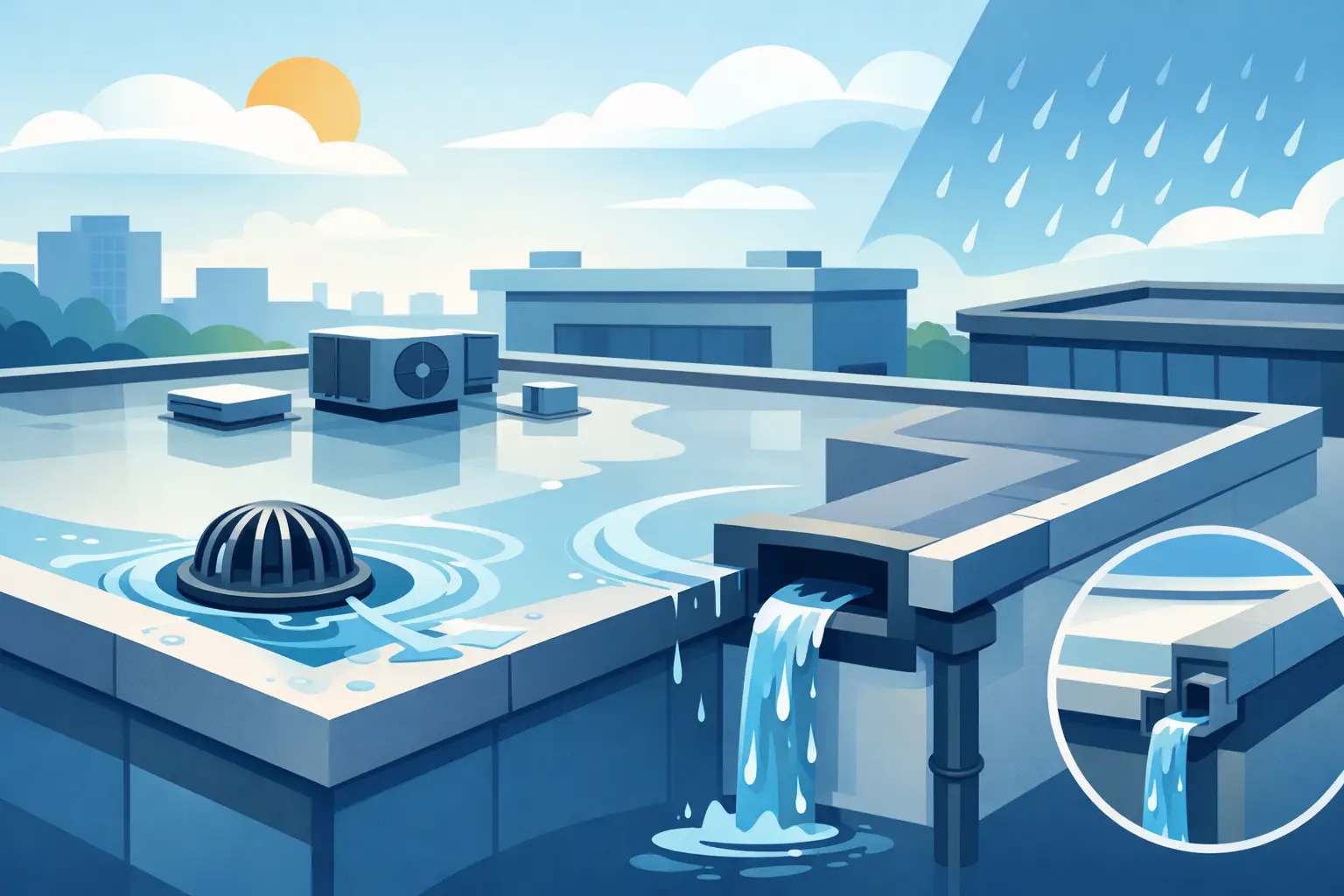
A flat roof should never hold water for days after a storm. Even a roof that looks level needs a planned path for rainwater to reach a drain, scupper, or gutter. The best flat roof drainage solutions are not one-size-fits-all products. They are systems designed around the roof’s size, slope, membrane condition, building use, and the amount of rainfall and debris the property receives.
In Roseburg, Coos Bay, Coos County, and Douglas County, frequent rain, windblown leaves, needles, and moss can turn a small drainage issue into a leak or premature roof failure. Good drainage protects the roofing membrane, reduces standing water, and helps prevent damage to insulation, decking, ceilings, and walls below.
Why Flat Roof Drainage Matters
The term “flat roof” can be misleading. A properly built flat roof has a slight slope that directs water to low points. If that slope is missing, blocked, or no longer effective, water ponds on the surface. Ponding water adds weight, accelerates membrane wear, and exposes seams and flashing to more stress.
A little water immediately after a hard rain is not always a concern. The issue is water that remains after the roof has had time to drain and dry. Persistent puddles often point to a clogged outlet, a sagging roof area, settled insulation, poor original slope, or a drainage system that is too small for the roof.
Drainage also affects maintenance costs. A roof that sheds water properly is easier to inspect, less likely to collect organic debris, and less likely to develop moss growth around low areas. Addressing drainage during repair or replacement is usually more cost-effective than repeatedly patching leaks caused by the same standing-water problem.
Best Flat Roof Drainage Solutions for Different Roofs
The right system depends on the roof structure and how water can safely leave the building. Many roofs use more than one drainage method. For example, tapered insulation may create the slope while scuppers and gutters carry the water away.
Tapered Insulation for Proper Slope
Tapered insulation is one of the most effective solutions when a roof does not have enough built-in slope. Rather than laying insulation at one uniform thickness, the material is installed in a planned layout that gradually directs water toward drains or scuppers.
This approach is especially useful during a flat roof replacement. It can correct broad low areas without major structural changes, while also improving insulation value. The trade-off is that tapered systems require careful design and installation. Water must have a clear route from every section of the roof to an outlet. If the layout is poorly planned, a new membrane can still end up with standing water.
For commercial buildings, manufactured homes, and residential additions, tapered insulation can often solve chronic ponding that simple repair work cannot. It is not always necessary on a roof with adequate slope, but it should be considered whenever water consistently collects in the same locations.
Scuppers and Downspouts
Scuppers are openings through a parapet wall or roof edge that allow water to exit into a downspout, conductor head, or open discharge area. They are common on commercial flat roofs and on homes with parapet walls because they provide a direct, visible path for water.
A scupper system works well when the roof can be sloped toward the perimeter. It is also easier to inspect than a hidden internal drain. Property owners can often see when a scupper is blocked by leaves, moss, or roof debris before the water backs up across the roof.
Scuppers must be sized for the roof area and local rainfall. They also need secure flashing at the roof edge. A scupper opening that is too small, improperly flashed, or set above the roof’s lowest point will not solve a drainage problem. Downspouts should discharge away from the foundation and should not empty onto lower roofs without adequate drainage capacity.
Internal Roof Drains
Internal drains collect water at low points on the roof and send it through piping inside the building. This system is common on larger commercial roofs where perimeter drainage is impractical or where the roof layout directs water toward the center.
When properly designed, internal drains keep water flow controlled and avoid exterior downspouts along the building face. They can be a sound choice for large roofs with multiple drainage zones. However, they need regular attention. Drain strainers must stay clear, and the drain body, clamping ring, membrane connection, and piping all need to remain watertight.
An internal drain has a higher consequence if it clogs. Water may build up across a large section of the roof before anyone notices. For that reason, good commercial roof design often includes secondary or emergency overflow drainage. These overflow outlets provide a backup route if the primary drains cannot handle the water.
Gutters at Low Roof Edges
Gutters are a practical option for many residential flat roofs, low-slope additions, covered decks, and manufactured homes. They collect runoff at the low edge and move it to downspouts. For a gutter system to work, the roof edge must be straight, the roof must slope consistently toward it, and the gutter must be large enough to handle heavy rain.
The main drawback is maintenance. Gutters collect leaves, needles, roof grit, and moss. In wooded parts of western Oregon, a gutter that is left untouched can clog quickly. Screens can reduce large debris, but they do not replace cleaning. Fine material can still build up inside the gutter and at the downspout outlet.
Crickets and Localized Drainage Corrections
A cricket is a small raised, sloped section built to divide water and move it around an obstruction. Crickets are commonly installed behind rooftop equipment, chimneys, curbs, and other areas where water tends to sit. They can also help redirect water away from a wall or toward a drain.
This is a targeted solution rather than a complete drainage system. A cricket will not correct an entire roof with poor slope, but it can eliminate a stubborn low area when the rest of the roof drains properly. During repair work, an experienced roofer can identify whether a local correction is enough or whether the larger roof slope needs to be rebuilt.
How to Choose the Best Flat Roof Drainage Solution
Start with the cause of the water problem, not the visible puddle alone. A roof inspection should look at the roof membrane, seams, flashing, drain locations, outlet sizes, roof deck condition, insulation, gutters, and downspouts. The best answer may be simple cleaning, but it may also require slope correction or replacement work.
Consider four practical questions:
- Where does water collect, and how long does it remain after rain?
- Is the existing outlet clogged, undersized, damaged, or located too high?
- Does the roof have enough slope to move water to the outlet?
- Is the roofing membrane still in condition to be repaired, or is replacement the better long-term value?
For a small residential roof, properly pitched gutters and clean downspouts may be all that is needed. For a commercial roof with repeated ponding, tapered insulation, internal drains, scuppers, or a combination of these may be the better investment. Building layout, roof access, parapet walls, plumbing routes, and budget all affect the decision.
Drainage Details That Cannot Be Overlooked
Drainage components only work when the surrounding roofing details are sound. The membrane must be correctly sealed at drains and scuppers. Flashing must protect transitions at walls and edges. Drain bowls need to sit at the true low point, not above it. A new drain on a roof with poor slope may still leave water trapped several feet away.
Roof penetrations also matter. Pipes, equipment curbs, vents, and skylights can interrupt water flow. A professional installation accounts for these areas so water is not forced against flashing or left to pool behind equipment.
For older roofs, it is also worth checking whether the deck has sagged. Structural movement can create low spots that no amount of gutter cleaning will fix. That calls for a closer evaluation before applying another coating or patch.
Maintenance Keeps Drainage Working
Even the best drainage design needs routine care. Roof drains, scuppers, gutters, and downspouts should be checked before the rainy season and after major windstorms. Remove leaves, moss, branches, and sediment before they compact and block the outlet.
Property managers should also watch for water stains, slow drainage, overflowing gutters, sagging roof areas, and changes in the way water exits the building. These warning signs are easier and less expensive to address before they become an emergency leak.
Rich Rayburn Roofing helps local homeowners and commercial property owners evaluate flat roof drainage as part of repair, maintenance, and replacement work. The goal is not to add components that a roof does not need. It is to build a clear, durable path for water and protect the investment underneath it.
If a flat roof still holds water after the weather clears, do not wait for the next leak to decide what to do. A careful inspection can show whether the answer is a cleared outlet, a localized slope correction, or a drainage plan built to last.