

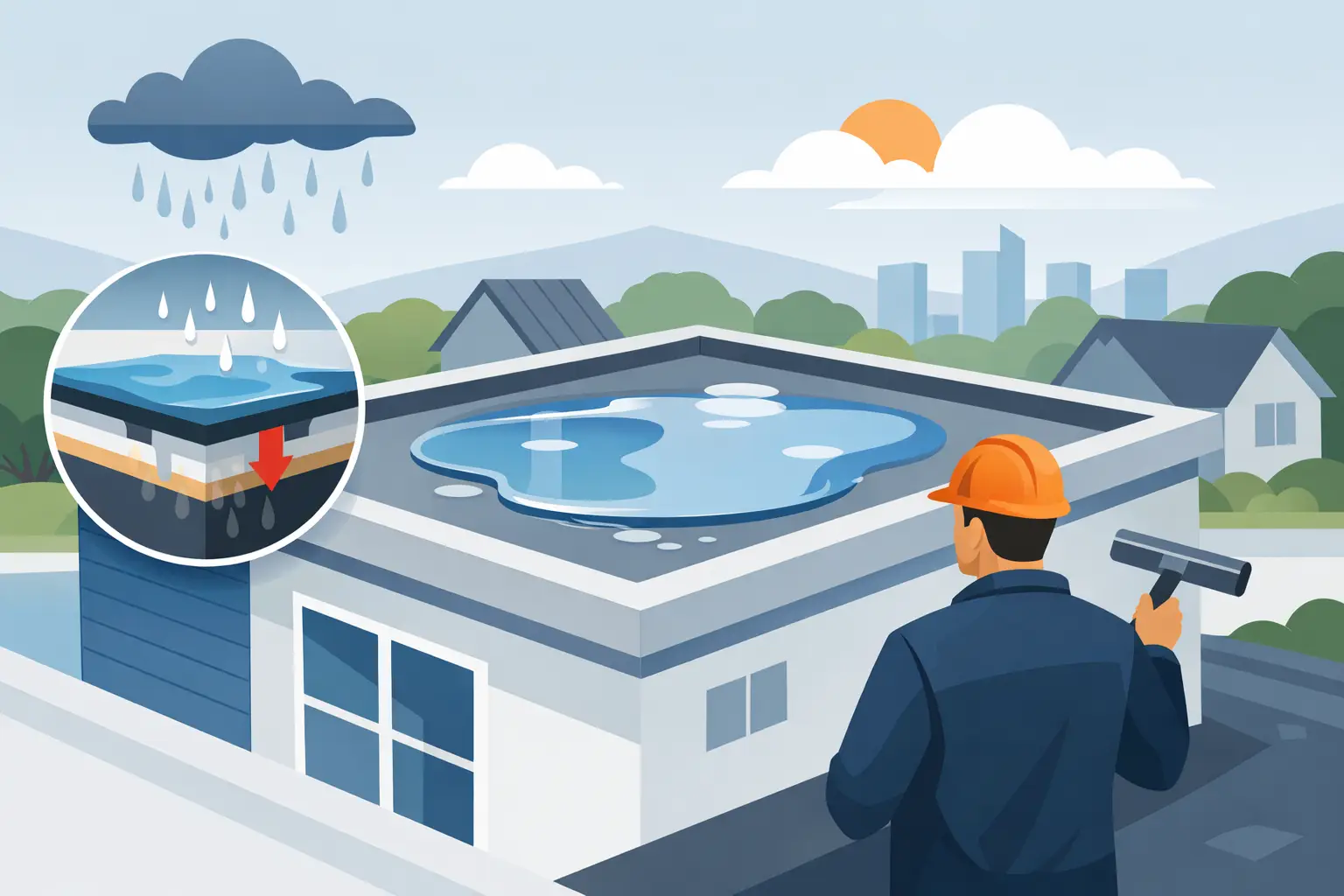
A flat roof should drain, not hold water for days. If you keep seeing puddles that stick around long after the rain stops, you are right to pay attention. Knowing how to stop roof ponding early can help you avoid leaks, membrane damage, rot, mold, and expensive structural repairs.
Ponding water is common on flat and low-slope roofs, especially as they age. In Oregon, where rain is part of life, that extra standing water puts more stress on roofing systems than many property owners realize. A small low spot can turn into a recurring problem, and once water starts finding weak seams or flashing, repairs can snowball fast.
What roof ponding actually means
Roof ponding is standing water that remains on a roof for more than 48 hours after rainfall. A little temporary water right after a storm is not unusual on some flat roofs. The concern starts when the roof does not shed that water in a reasonable amount of time.
That standing water adds weight, speeds up wear on the membrane, and often points to an underlying drainage or structural issue. On commercial buildings, manufactured homes, and residential flat roofs, ponding can shorten the life of the roof if it is not corrected.
Why ponding happens in the first place
Most ponding problems come down to slope, drainage, or roof condition. Sometimes a roof was not pitched properly from the start. In other cases, the roof deck has settled over time, insulation has compressed, or drains and scuppers are clogged with debris.
On older roofs, repeated moisture exposure can soften materials and create low areas that trap even more water. That is one reason ponding tends to get worse instead of staying the same. What starts as a shallow dip can become a chronic weak point.
Poor maintenance also plays a part. Leaves, moss, dirt, and roofing debris can block drainage paths and make a roof hold water in places where it used to drain. In wet parts of Douglas County and Coos County, that buildup can happen faster than many owners expect.
How to stop roof ponding: start with the cause
If you want to know how to stop roof ponding, the first step is not patching the symptom. It is identifying why water is staying there. A proper roof inspection looks at the membrane, seams, flashing, drains, scuppers, edge details, insulation, and the roof structure itself.
In some cases, the fix is straightforward. A blocked drain or clogged scupper may be the main issue. In others, ponding points to sagging decking, poor design, or aging materials that need more than routine repair.
This is where experience matters. The right repair depends on whether the problem is maintenance-related, installation-related, or structural. Treating all ponding the same can waste money and leave the real issue in place.
Simple fixes that may solve minor ponding
Some roof ponding issues can be improved with maintenance and targeted repair. Clearing debris from drains, gutters, downspouts, and scuppers is one of the first things to check. If water has no clear path off the roof, even a well-built system can pond.
Minor low spots can sometimes be corrected with localized repair methods, depending on the roofing system. A contractor may add tapered materials to improve drainage in a trouble area or rebuild part of the affected section if the membrane and substrate are still otherwise sound.
Seam repair and flashing repair may also be needed if ponding has already started to break down vulnerable areas. These repairs do not always eliminate the low spot itself, but they can stop active leaks while a longer-term plan is made.
When drainage improvements are the real answer
If ponding is widespread or keeps returning, drainage often needs to be redesigned or improved. That may mean adding or relocating drains, enlarging scuppers, adjusting gutters, or building in tapered insulation to guide water toward exits.
Tapered insulation is a common fix on flat roofs because it creates slope without fully reframing the roof. It can be a practical solution when the deck is basically sound but the roof does not move water well. The trade-off is cost. It is more involved than a basic repair, but often much less disruptive than a complete structural rebuild.
On commercial properties, drainage improvements can make a big difference in roof performance and maintenance costs over time. On manufactured homes and residential flat roofs, they can also help reduce recurring leak calls and interior damage.
How to stop roof ponding when the roof is failing
Sometimes the honest answer to how to stop roof ponding is replacement, not repair. If the membrane is near the end of its life, if the insulation is saturated, or if multiple low areas have developed across the roof, repairs may only buy limited time.
A replacement gives the chance to correct the drainage design, address hidden damage, and install a system built to perform better in local weather conditions. For some properties, that is the more cost-effective move in the long run, even if the upfront price is higher.
This is especially true when ponding has already led to leaks, interior staining, soft decking, mold risk, or repeated emergency service calls. At that point, the roof is not just holding water. It is affecting the building below it.
Warning signs you should not ignore
Standing water is the obvious one, but it is not the only sign of trouble. Bubbling or blistering in the membrane, stained ceilings, peeling paint, musty odors, moss growth, and visible sagging can all point to ponding-related damage.
You may also notice water marks around roof penetrations, HVAC curbs, or edge flashing. Those areas often fail first because ponding keeps them wet longer and exposes them to more stress.
If water is still on the roof two days after rain, it is time for an inspection. Waiting through another season usually does not improve the situation.
What property owners should avoid
It is tempting to treat ponding with a quick coating or surface patch, especially if the roof is not actively leaking inside yet. Sometimes coatings have their place, but they do not correct poor drainage on their own. If water still sits in the same place, the underlying issue remains.
It is also a mistake to assume all flat roofs pond and that nothing can be done. While some roofs are harder to drain perfectly than others, persistent ponding is not something to ignore or normalize.
And if you are thinking about walking a wet roof to inspect it yourself, be careful. Flat roofs can be slippery, and some weak areas are not obvious until they give way. A professional inspection is safer and usually more useful.
Why local conditions matter
Roofing decisions in Oregon should account for steady rain, seasonal debris, moss growth, and moisture exposure over time. A repair approach that might hold up in a drier climate may not last the same way here.
That is why local experience matters when diagnosing ponding. A contractor familiar with flat roofing in Roseburg, Coos Bay, and the surrounding area will know what repeated wet conditions do to membranes, drains, flashing, and roof decks. They will also know when a lower-cost repair is realistic and when it is just delaying a bigger problem.
For property owners who want practical answers, that matters more than a sales pitch. Rich Rayburn Roofing has built its reputation by focusing on workmanship, efficient crews, and roofing solutions that make sense for the building in front of them.
The best time to deal with ponding
The best time is before the next leak. Once water starts entering the building, repair costs usually expand beyond the roof to insulation, ceilings, walls, flooring, and sometimes electrical systems.
Even if the roof is not leaking yet, chronic ponding shortens service life and raises the odds of failure during heavy weather. A timely inspection can help you sort out whether the fix is basic maintenance, a repair to improve drainage, or a larger correction.
If your flat roof keeps holding water after the rain is over, do not assume it will work itself out. Roof ponding is usually a sign that the roof needs attention, and the sooner you deal with it, the more options you usually have.